
Urine Leakage During Pregnancy: Third Trimester Solutions
Urine leakage in the third trimester is common, but "common" doesn't mean you have to just live with it until after delivery. This post breaks down why leakage happens (it's rarely just "a weak pelvic floor"), why more Kegels isn't automatically the fix, and how pelvic floor physical therapy during pregnancy can help you manage symptoms now while preparing your body for birth and postpartum recovery.

You sneeze.
You laugh at your partner's terrible joke.
You go to stand up off the couch.
And there it is. A leak.
Somewhere along the way, someone probably told you that's just what happens when you're growing a human. You laughed it off, maybe bought the pads, and moved on with your day.
Here's the thing though: I want you to stop moving on with your day.
Leakage tends to show up more as pregnancy goes on, especially in the third trimester, when everything else about your body already feels like it's changing by the day. But common isn't the same as normal. And it's definitely not the same as "nothing can be done about it."
Your pelvic floor and pressure-management system are having a hard time keeping up with everything pregnancy is asking of them right now. Pelvic floor physical therapy can help you figure out why you're leaking and give you real strategies to improve it during pregnancy. You don't have to wait until the baby is here.
Is Leaking (aka Pregnancy Incontinence) Actually Normal in the Third Trimester?
Here's what you've probably heard: "That's just pregnancy." "The baby is sitting on your bladder." "It'll get better after you deliver."
None of that is technically a lie. Pregnancy really does place more demand on your bladder and pelvic floor than your body has ever dealt with before.
But that doesn't mean leaking should just get shrugged off. And you don't have to wait until postpartum to start addressing it. Working on pelvic floor function now can help manage what you're dealing with today, and it sets your body up for an easier birth and recovery too.
What Causes Urine Leakage During Pregnancy?
Your pelvic floor is working harder than it ever has.
Quick refresher: your pelvic floor is the group of muscles that supports your bladder, uterus, and bowel, kind of like a hammock at the base of your pelvis. As your uterus and baby grow, that hammock must manage a lot more weight and pressure. By the third trimester, the job description has changed completely from where it started.
There's more pressure on your bladder.
Growing baby plus growing uterus equals less room in there and more pressure pushing down. That's part of why you're peeing more often and why you're leaking more. It tends to show up most with coughing, sneezing, laughing, lifting, exercising, or just getting up from a chair.
And no, it's not always a "weak" pelvic floor.
I wish someone would put this on a billboard! Leakage does not automatically mean your pelvic floor is weak. Sometimes it is. But sometimes those muscles are overactive or tight, fatigued, poorly coordinated, or just too slow to respond when pressure suddenly increases.
This is exactly why "just do more Kegels" isn't always the answer. If your pelvic floor is already overactive, squeezing it harder isn't solving the problem. It might be making it worse!
How Your Core, Breathing, and Pelvic Floor Work Together
Your diaphragm, your abdominal muscles, and your pelvic floor are supposed to coordinate with each other, like a well-rehearsed trio.
During pregnancy, your rib cage shifts position. Your abdominal wall changes length and tension. Your posture adjusts. Your breathing mechanics change. Your baby grows and moves. All that changes how pressure moves through your abdomen and pelvic floor.
When pressure keeps pushing down without your pelvic floor responding the way it should, leakage happens. This is why pelvic PT never just looks at the pelvic floor in isolation.
How to Stop Leaking During Pregnancy
Start with your breathing.
Try 360-degree breathing: letting your ribs, belly, back, and pelvic floor all expand together, instead of just forcing your belly out or holding your breath. This breath coordination helps your pelvic floor learn to respond to pressure changes the way it's supposed to.
Stop automatically reaching for more Kegels.
Kegels can absolutely help some people. But your pelvic floor's job isn't just to squeeze harder. It needs to contract, relax, lengthen, and respond appropriately depending on what your body is doing. A pelvic floor PT can tell you what your muscles need instead of guessing.
Pay attention to when you leak.
Only with a sneeze or cough? During exercise? When you lift your toddler? When your bladder is full? On the way to the bathroom with urgency? The pattern gives real clues about what's going on.
How Pelvic Health PT Helps with Pregnancy Bladder Leakage
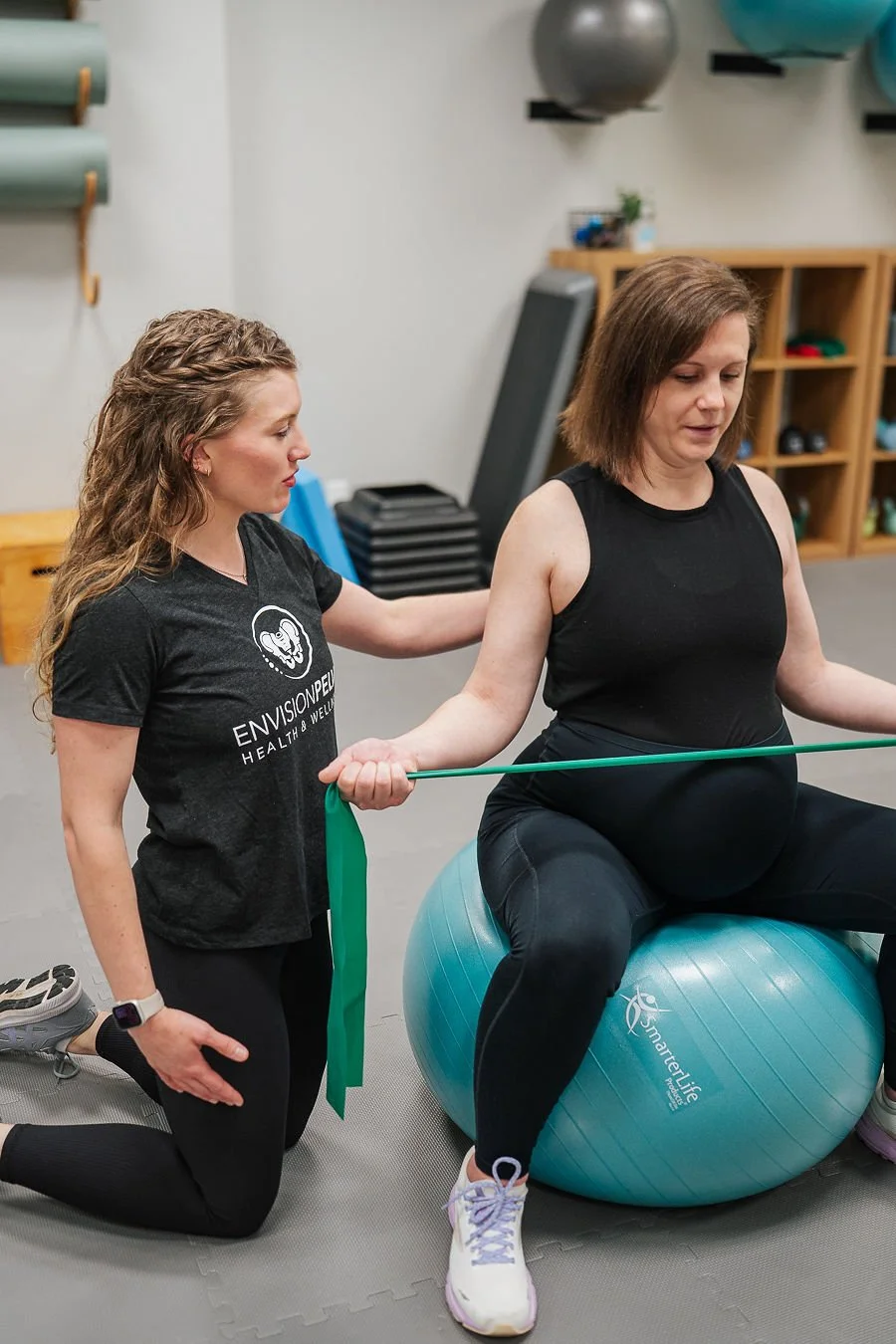
A pregnancy pelvic PT evaluation looks at your pelvic floor strength, tension, relaxation, and coordination, your breathing mechanics, core function, rib cage mobility, hip and pelvic mobility, posture, how you manage pressure throughout your day, and your bladder habits.
From there, treatment gets built around what's contributing to your leakage, not a generic exercise sheet. That might include pelvic floor coordination work, breathing and pressure management, strengthening (when it's appropriate), relaxation work (also when appropriate), core and hip work, bladder education, and adjustments to how you're moving or exercising.
Pelvic Floor PT Isn't Just a Postpartum Thing
I hear this all the time: "I thought pelvic PT was something you do after you have the baby."
Pregnancy is actually a great time to work on these symptoms before delivery. And the work doesn't stop at birth prep. It can carry right into pelvic floor relaxation and lengthening, labor positioning, pushing strategies, and a real plan for postpartum recovery.
When Should You See a Pelvic Health PT for Leaking?
Consider booking an evaluation if:
You're leaking with coughing, sneezing, laughing, or exercise.
Leakage is getting more frequent as pregnancy progresses.
You're dealing with real urinary urgency or frequency.
You're skipping workouts because you're worried about leaking.
You're not sure whether your pelvic floor needs to be stronger or more relaxed.
Or you simply want to prepare your body for birth and postpartum recovery.
You Don't Have to Wait Until After Baby to Address Urine Leakage
Leakage in the third trimester may be common. That doesn't mean you have to ignore it until after delivery.
Your pelvic floor is adapting to a huge amount of change right now. Understanding how it's functioning, and how it works together with your breathing, core, hips, and movement, can help you manage leakage today and prepare your body for what's next.
Pregnancy Pelvic Floor Physical Therapy in Chicago
If you're experiencing urine leakage during pregnancy and looking for a pregnancy pelvic floor physical therapist in Chicago, Envision Pelvic Health & Wellness can help. Our pelvic floor physical therapists work one-on-one with pregnant patients on bladder leakage, pelvic pain, pressure, core changes, and birth preparation.
We proudly serve Chicago's Northwest Side and surrounding communities, including Norwood Park, Edison Park, Park Ridge, Niles, Des Plaines, and Jefferson Park.
Ready to stop writing off bladder leakage as "just part of pregnancy"? Schedule a pelvic floor physical therapy evaluation and let's figure out what's going on.
You are welcome to:
Book a free discovery call to learn if pelvic floor physical therapy is right for you.
Schedule a pregnancy pelvic floor PT evaluation for personalized, one-on-one care.
Call our clinic with questions about your symptoms, insurance, or payment options.
Learn more about our pregnancy and postpartum services and meet our team.
You don't have to wait until after your baby is born to start feeling better. The sooner we understand what's contributing to your symptoms, the sooner we can help you move through pregnancy with more confidence and less discomfort.
Book a discovery call or submit a contact form today to learn more.
Or, if you’re ready to book your initial evaluation use the link below.
Frequently Asked Questions
-
It's never too early. Many people benefit from starting during the first or second trimester, while others begin later in pregnancy to focus specifically on birth preparation. Every trimester has different goals, and a pregnancy physical therapist can tailor treatment to your needs. Read our blog When to Start Pelvic Floor Therapy During Pregnancy.
-
Research suggests that regular perineal massage beginning around 32- 34 weeks of pregnancy may reduce the risk of more severe tearing, particularly for first-time vaginal births. It can also help you become more comfortable relaxing your pelvic floor during stretching.
-
Not necessarily. While pelvic floor strength is important during pregnancy, labor requires your pelvic floor muscles to relax and lengthen. A pelvic floor physical therapist can help determine whether you would benefit more from strengthening, relaxation, or a combination of both.
-
Absolutely! Many people come to pregnancy PT simply because they want to prepare for labor and delivery. Pregnancy physical therapy isn't just about treating pain—it's also about education, birth preparation, breathing, pushing strategies, pelvic floor coordination, and postpartum planning.